i imba / design document

Document check · design document

Catch the contradiction before the client does

imba is an app for running AI agents. Each agent works in a chat, called a spawn, inside one folder of files. Most documents a business delivers live in such a folder: a final report with its budget and annexes, a tender bid, an annual report, a policy set, next to the contract or brief they must agree with.

Several agents write on one set of documents at the same time, each in its own spawn and its own part. Each agent sees only its own changes, so the documents drift apart: one agent shortens the delivery period in the report while another still prices the old one in the budget. Document check is a new command that reads every page, finds statements that cannot both be true, fixes what the reference documents settle, and checks every document again in rounds until one comes back clean.

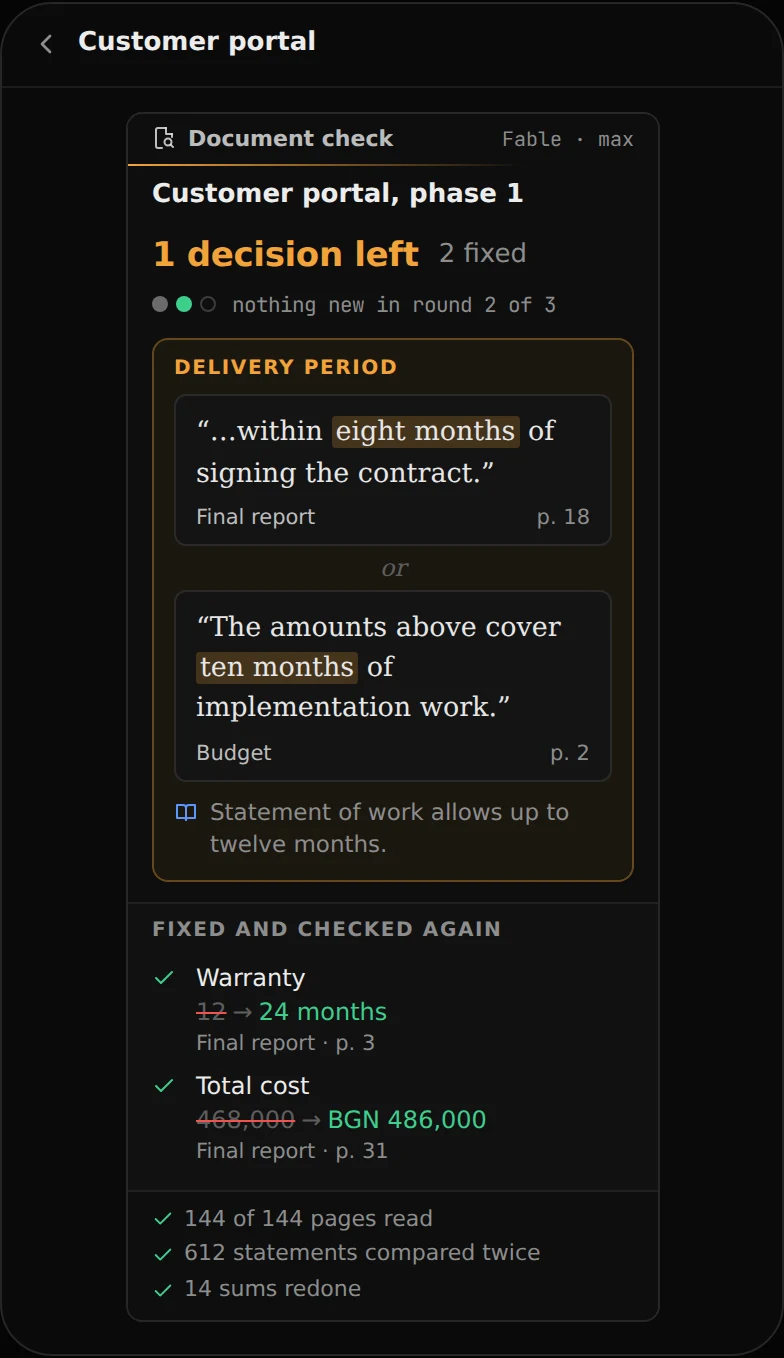
Final reportpage 18

“The complete portal, including data migration and staff training, was delivered within eight months of signing the contract.”

Budgetpage 2

“The amounts above cover ten months of implementation work, followed by the warranty period.”

Both can go to the client today. Only one can be true.

Any set of documents that goes out

The check reads prose, not code, and it works on any set of business documents that must agree with each other before delivery. A few of the sets it is meant for, each with the kind of clash it catches:

Client deliverablesThe final report says the work took eight months. Its budget covers ten.
Tender bidsThe technical proposal names nine key experts. The price offer pays for seven.
Annual and board reportsThe chair's letter says revenue grew 12 percent. The accounts show 9.
Proposals and statements of workThe proposal includes staff training. The statement of work leaves it out.
Due diligence and audit reportsThe summary calls a lease expired. The annex lists it as running to 2028.
Policies and proceduresThe policy asks for two signatures on a payment. The procedure asks for one.
Grant applicationsThe work plan runs 24 months. The budget pays the staff for 18.
Contracts and their annexesThe contract says payment within 30 days. The payment annex says 45.

The documents the set must agree with, such as the contract, the statement of work, the client's brief or terms of reference, are its reference documents. They decide which side of a clash is wrong.

What was asked

A check like imba's code review, which sends several read-only AI reviewers over a change and confirms what they find. This one reads business documents instead of code.

Business documents to be deliveredReports, proposals, bids, contracts, plans, policies and CVs, written by several agents at once. Prose, in Word and PDF.
Every statementEach checkable statement is pulled out with its quote and page, then compared with every other statement on the same subject.
Several reviewersSeven read-only reviewers in each round, and every subject is compared by two of them.
Guaranteed to finish the workimba checks each step itself before the next starts. A skipped page or a silent reviewer stops the round.
Rounds until cleanThe check repeats until a round finds nothing new, up to a round limit the operator sets.
The clash on the cardThe result card quotes the two statements. Six looks for it are drawn below, at phone and desktop width.

How one round runs

A round has six steps. After each step imba checks the work itself, in code, before the next step starts. A reviewer's word that it finished is never taken alone.

  1. 0

    Choose the documents before round 1

    Every Word, PDF, OpenDocument, markdown and text file in the spawn's folder and its subfolders. Word's lock files and the Skip list are left out. Over the document limit of 60, the run stops and says how many it found, rather than checking part of them.

    imba checksA PDF with no text in it, such as a scan, is named on the card as unreadable. Nothing is skipped without saying so.
  2. 1

    Read imba

    imba turns each document into text once, before any reviewer starts. Every line carries its document, page and section heading, so Claude and Codex reviewers read the same words.

    imba checksEvery page of every document was read.
  3. 2

    List the statements 2 readers

    The documents are split into two even batches. Each reader lists every checkable statement in its batch: the sentence word for word, its page, the claim in one plain line, and its subject, such as “warranty” or “delivery period”.

    imba checksEvery quote is found on its page. A quote that is not there is dropped.
  4. 3

    Compare 3 hunters

    Statements that share a subject are bundled, and each bundle goes to two of the three hunters. A hunter calls each pair agree, clash or not comparable, looking for six things: figures, dates, duties, scope, names and logic.

    imba checksEvery subject came back from two hunters.
  5. 4

    Check against the references 2 checkers

    Checkers test every statement against the reference documents and answer holds, wrong or cannot tell, citing the page that decides. They also redo every total and percentage, and every figure written out in words.

    imba checksEvery statement has an answer. imba adds up each sum itself, so a model's arithmetic never decides alone.
  6. 5

    Confirm the spawn's agent

    The agent reads both passages in place and looks for a reading under which both are true, such as another lot, another phase or another currency. Each clash is kept with its kind, or dropped with the reason.

    imba checksEvery clash has a written reason, kept or dropped.
  7. 6

    Fix the spawn's agent

    Where a reference document or a redone sum shows which side is wrong, the agent rewrites that side in the document's own words. A clash nothing settles is never edited. It goes to the operator with both statements and a recommended answer.

    imba checksEvery change is found in its file afterwards.

A reviewer that gives no answer, or answers in the wrong shape, is run again. A round is never counted with a gap in it.

Rounds until clean

A fix can start a new clash: correcting the total cost on page 31 can break a sum on page 33. So after any fix, the next round reads every document again from the start, not only the changed pages. The run ends when a round finds nothing new, or when the round limit is reached.

Roundread to confirm Newclash? Fix Endsclean, or decision left Not clean yes no yes, at the limit every document again
3 rounds by default

The round limit is the operator's: any number from 1 to 20 in Settings, or for one run with /rd rounds 6.

Clean after 2 rounds

A whole round found nothing new, and nothing waits on the operator.

1 decision left

Nothing new in the last round, but a clash the reference documents cannot settle waits on the operator.

Not clean after 3 rounds

The last allowed round still found something. The card shows what and on which pages.

Each clash carries one word for how sure the run is. imba works the word out from the records; the agent never chooses it.

proven

A reference document or a redone sum shows one side wrong.

sure

Both hunters found it and the agent confirmed it.

likely

One hunter found it and the agent confirmed it. Dropped when Keep one-hunter finds is off.

Starting a run

The operator types /rd, short for review documents, in a spawn working in the documents' folder. Words after it change that one run only; the saved settings stay as they are.

TypedWhat the run does
/rdChecks every document in the folder with the saved settings.
/rd phase-1/Checks one subfolder.
/rd "Final report.docx" "Budget.docx"Checks only the named files.
/rd against "Statement of work.pdf"Uses that document as the reference for this run.
/rd rounds 6Allows up to six rounds.
/rd 4Runs four hunters.
/rd codexRuns every reviewer on Codex.
/rd planEdits nothing and ends with a fix plan.
/rd norefSkips the check against the reference documents.

What gets fixed

Automatic fix is on by default, and only for clashes a reference document or a redone sum settles. Every fix is checked by the next full round like any other statement.

  • Word filesA tracked change by “imba”, which the document owner accepts or rejects in Word. imba refuses the change when the old words are missing from the page or appear on it twice.
  • Markdown and textEdited in place.
  • PDFNever edited. The new wording goes into the fix plan.
  • A clash nothing settlesNever edited. Both statements go to the operator with the agent's recommended answer.
Final report.docxReviewTrack Changes: On

1.3 Warranty

All delivered components carry a warranty of 12 months24 months from the date of acceptance.

Defects reported within the warranty period are corrected at no cost to the client.

imba · Deleted12 months
imba · Inserted24 months
Page 3

Every setting

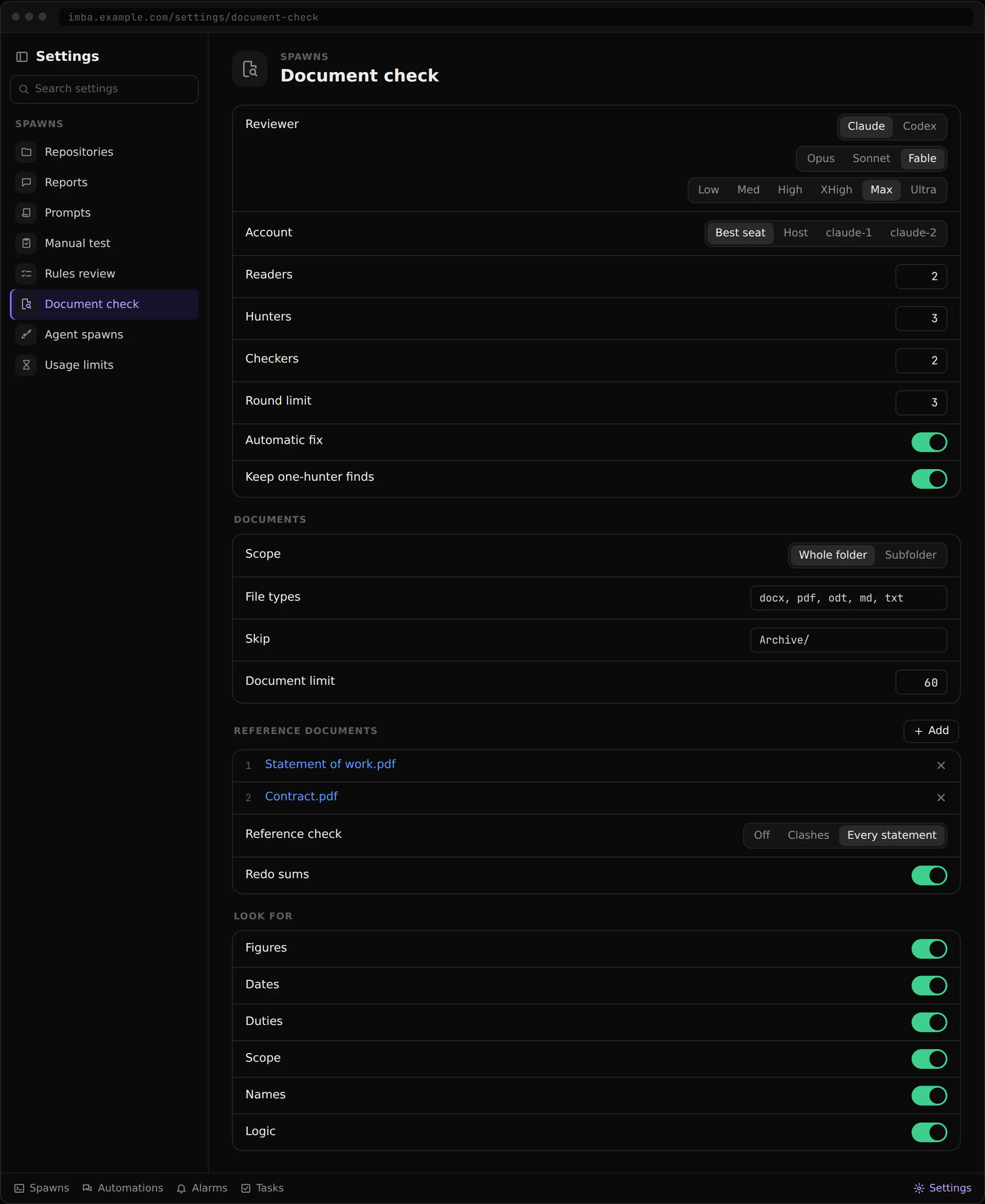
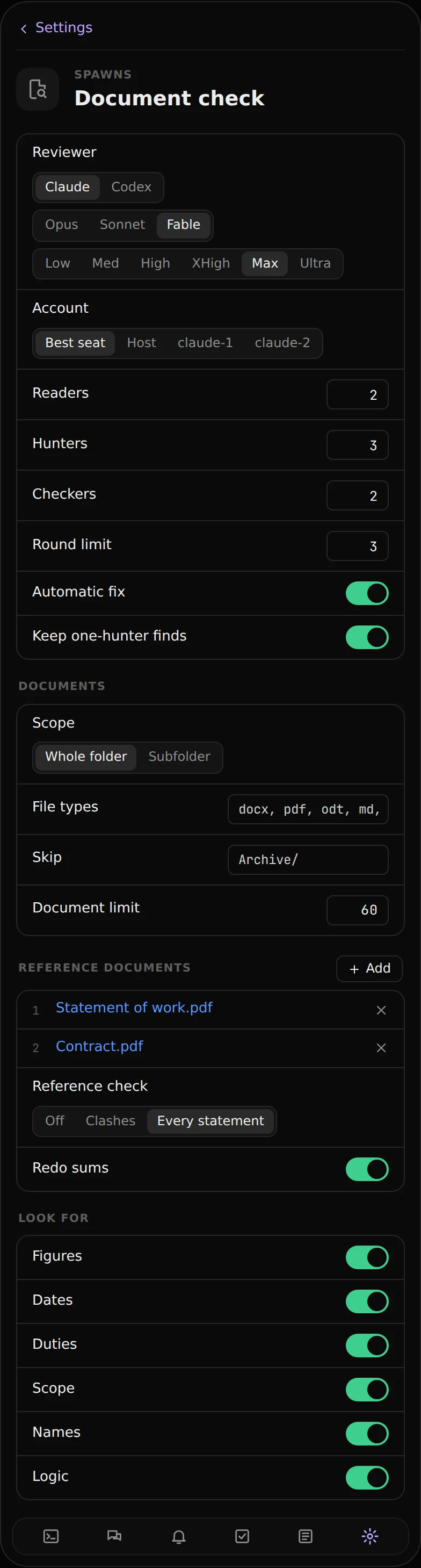
A new page, Settings, Document check, sits under Spawns right after Rules review. Each choice saves on the press, and each control takes a number through the Settings page's existing numbering, so no new letter key is taken.

The page
Settings, Document check, on a desktop
Desktop. The defaults, under Spawns in the settings list.
Settings, Document check, on a phone
Phone. The same page, controls under their names.
SettingDefaultWhat it decides
Reviewers
ReviewerClaude, Fable, MaxThe agent, model and effort for every reviewer.
AccountBest seatThe login the reviewers use: the best free seat, the host's own, or a named one.
Readers2How many reviewers list the statements.
Hunters3How many compare them. Each subject always goes to two.
Checkers2How many test statements against the reference documents and redo the sums.
Round limit3The most rounds a run may take, from 1 to 20.
Automatic fixOnFixes what a reference document or a sum settles. Off ends with a fix plan.
Keep one-hunter findsOnKeeps clashes only one hunter found, marked likely.
Documents
ScopeWhole folderThe spawn's whole folder, or one subfolder.
File typesdocx, pdf, odt, md, txtWhich files count as documents.
SkipemptyPaths never read, such as an archive folder.
Document limit60Above it the run stops and says how many it found.
Reference documents
The listemptyThe contract, statement of work, brief or terms of reference, in order; a higher one wins when two disagree. Empty means the readers mark them.
Reference checkEvery statementOff, clashes only, or every statement checked against the references.
Redo sumsOnRecomputes every total, percentage and figure in words.
Look for
FiguresOnTwo amounts or quantities for one thing, or a figure that differs from its words.
DatesOnTwo deadlines, periods or validity terms for one thing.
DutiesOnTwo obligations that cannot both be met, or “shall” against “may”.
ScopeOnSomething included in one document and left out in another.
NamesOnTwo names for one party, person, role or product.
LogicOnStatements that hold alone but together imply something false.

Six looks for the card

The card arrives in the chat under the agent's reply when the run ends. Every look shows the same run on one client delivery: two clashes fixed, one left for the operator, and nothing new in round 2 of 3. Each one shows the clash itself, not only its counts.

A

Verdict first

recommendedOpen the full design →

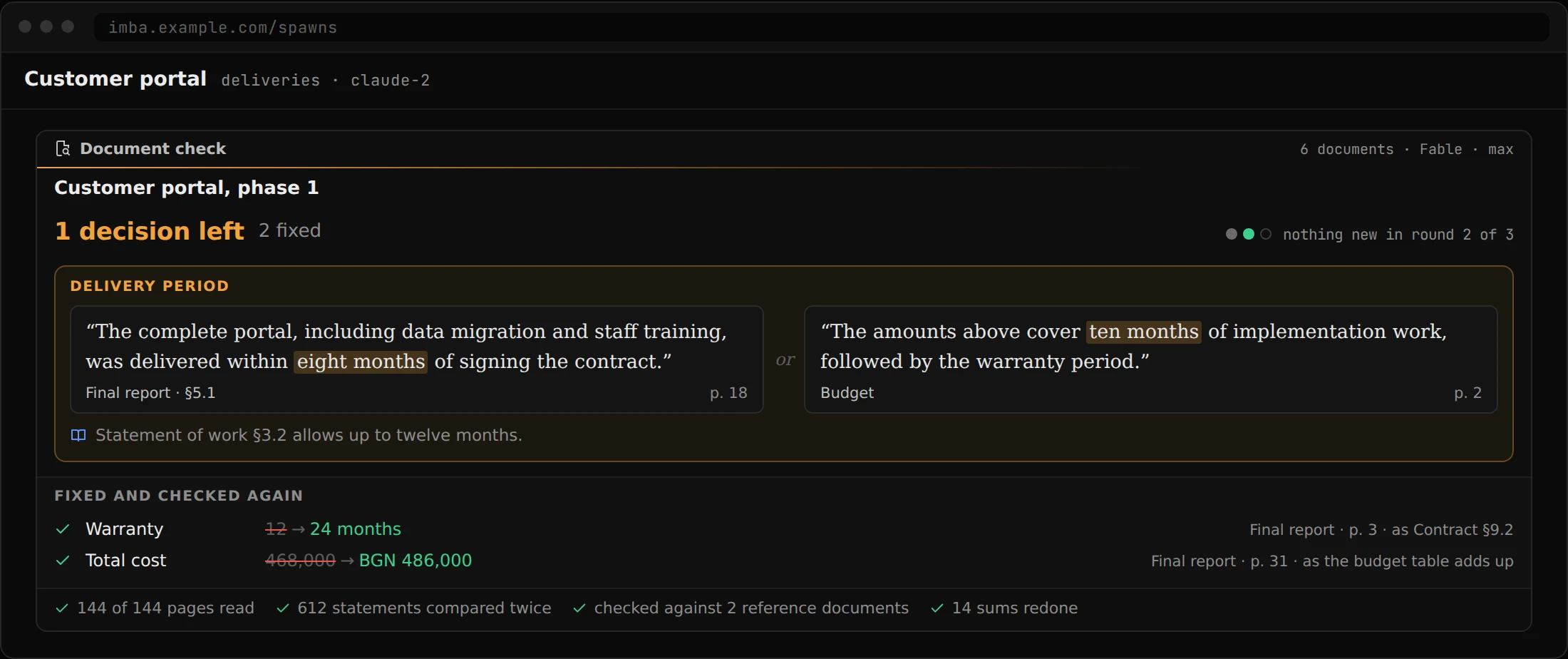
The verdict comes first, large, in the colour of the ending. Under it the decision left, with both statements quoted on two slips and the reference line that could not settle it. Fixes follow as old value to new, and the last line says what was checked.

Waiting on one decision
A waiting on a decision, desktop
Desktop. Three round dots: done, clean, not needed.
A waiting on a decision, phone
Phone. The slips stack, quotes cut to the clashing words.
Clean
A clean, desktop
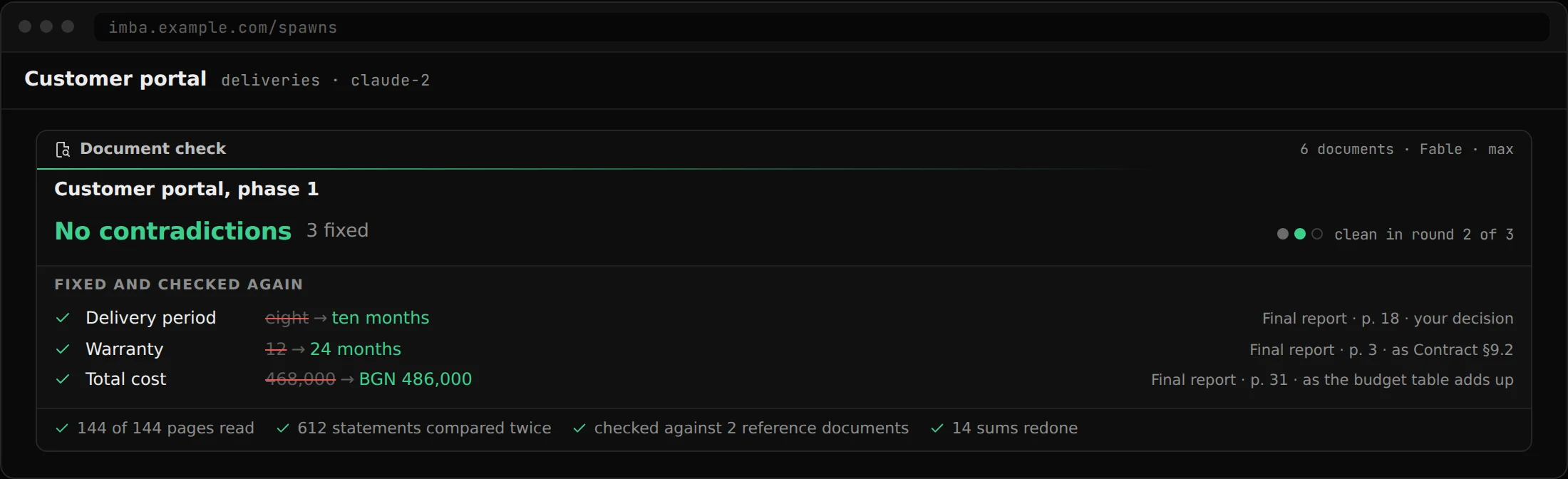
Desktop. Green, and the operator's decision is now a fix.
A clean, phone
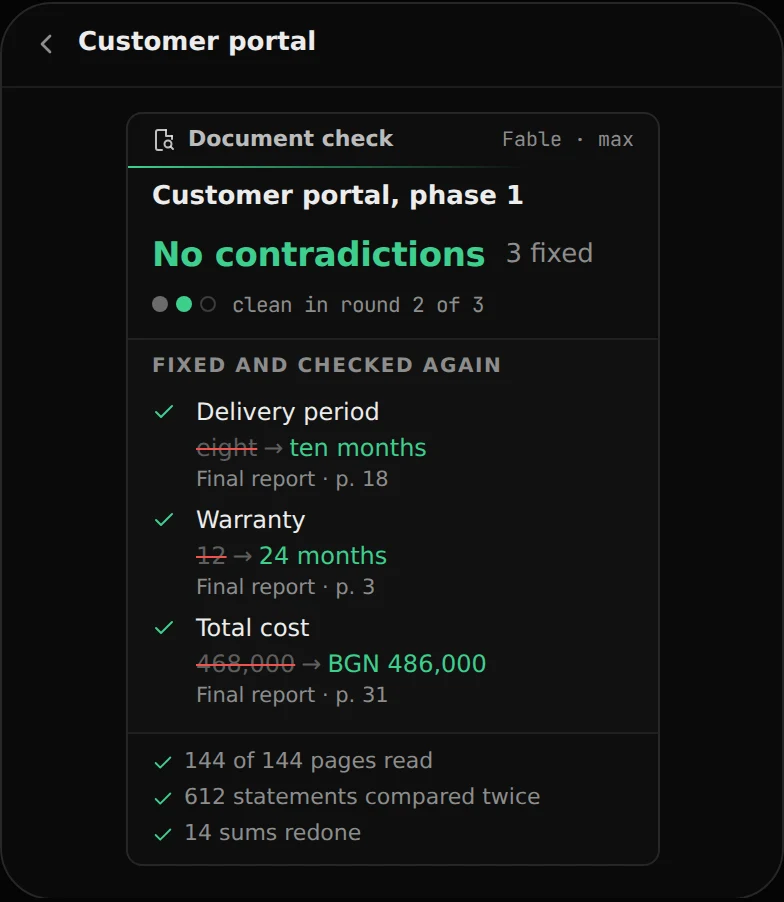
Phone.
Round limit reached
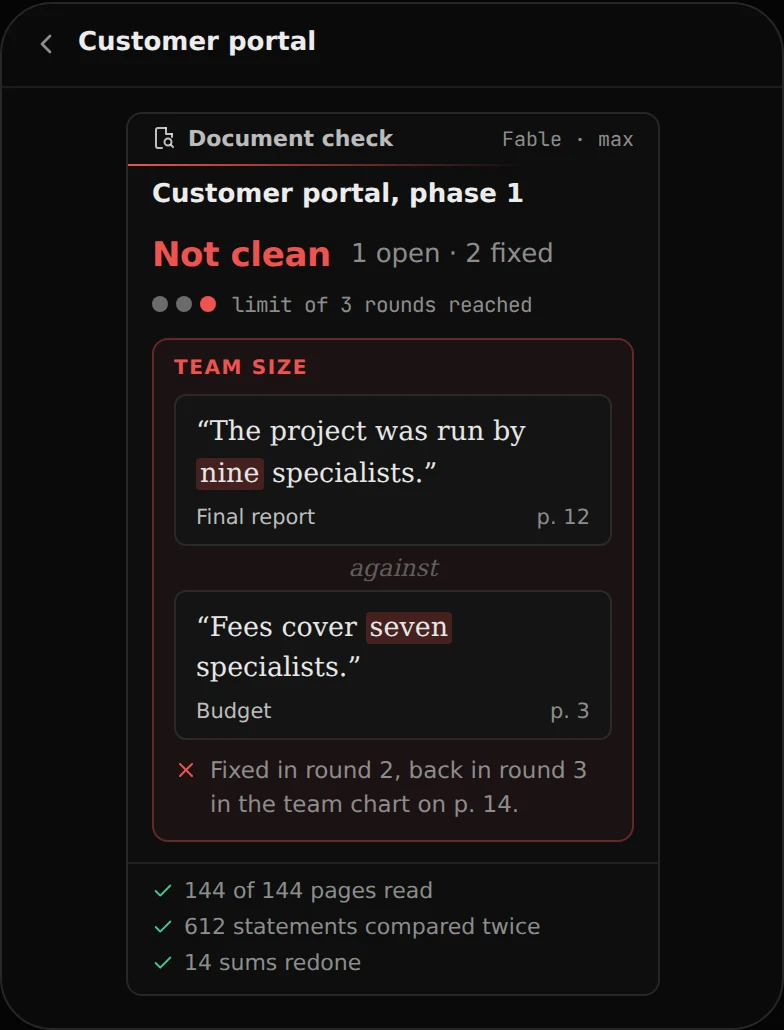
A not clean, desktop
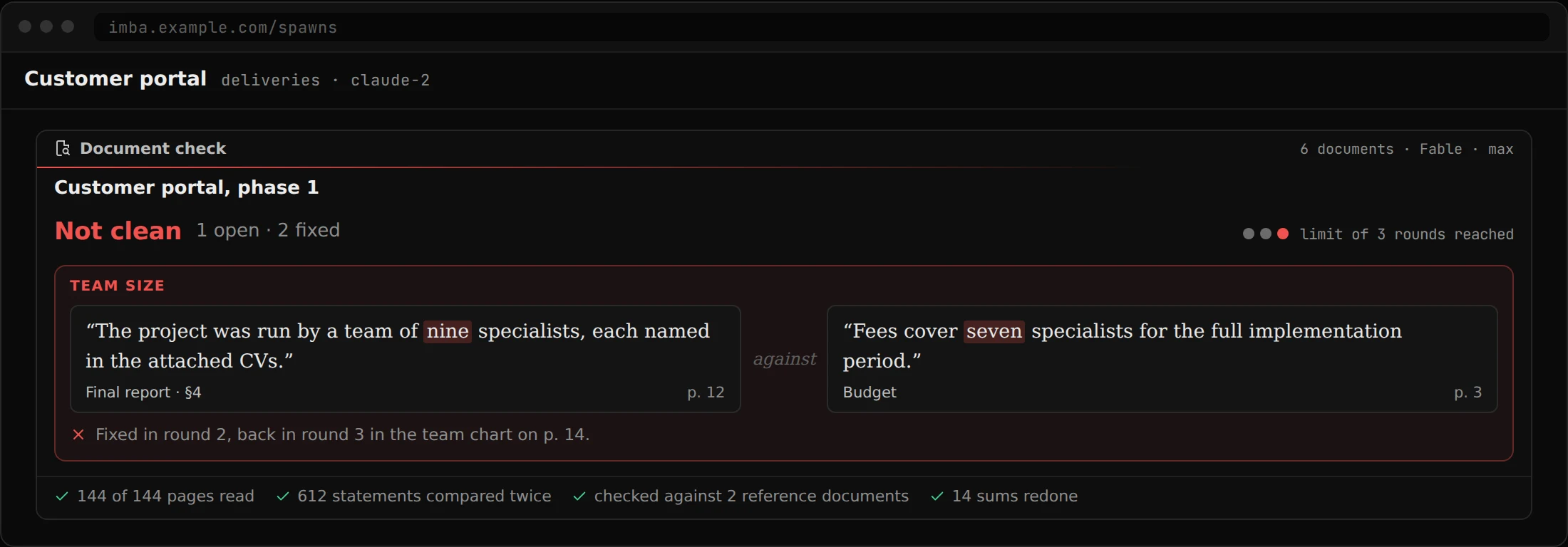
Desktop. Red: a clash fixed in round 2 came back in round 3.
A not clean, phone
Phone.
Why it could work

The first line answers whether the documents can go out. The clash is read in their own words without opening anything.

What it costs

The tallest of the six on a phone while a decision is open.

Keys

None. The card has no controls, like the Review card.

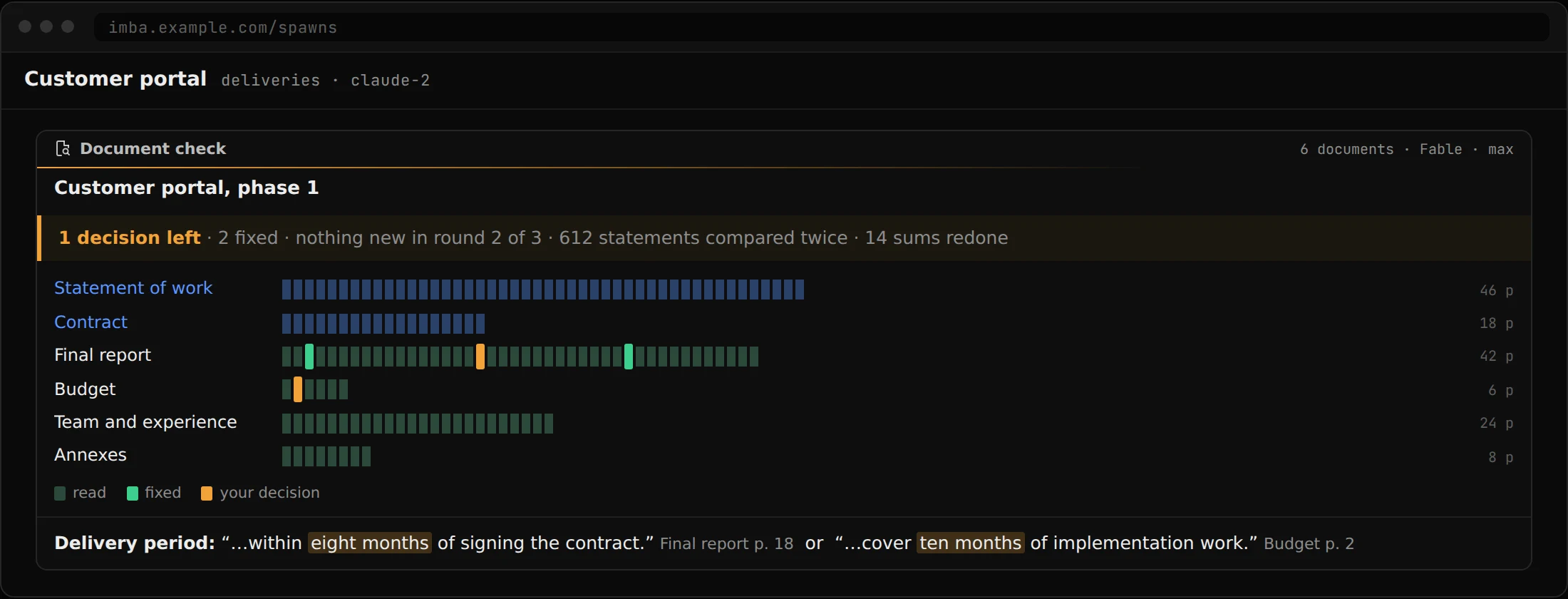
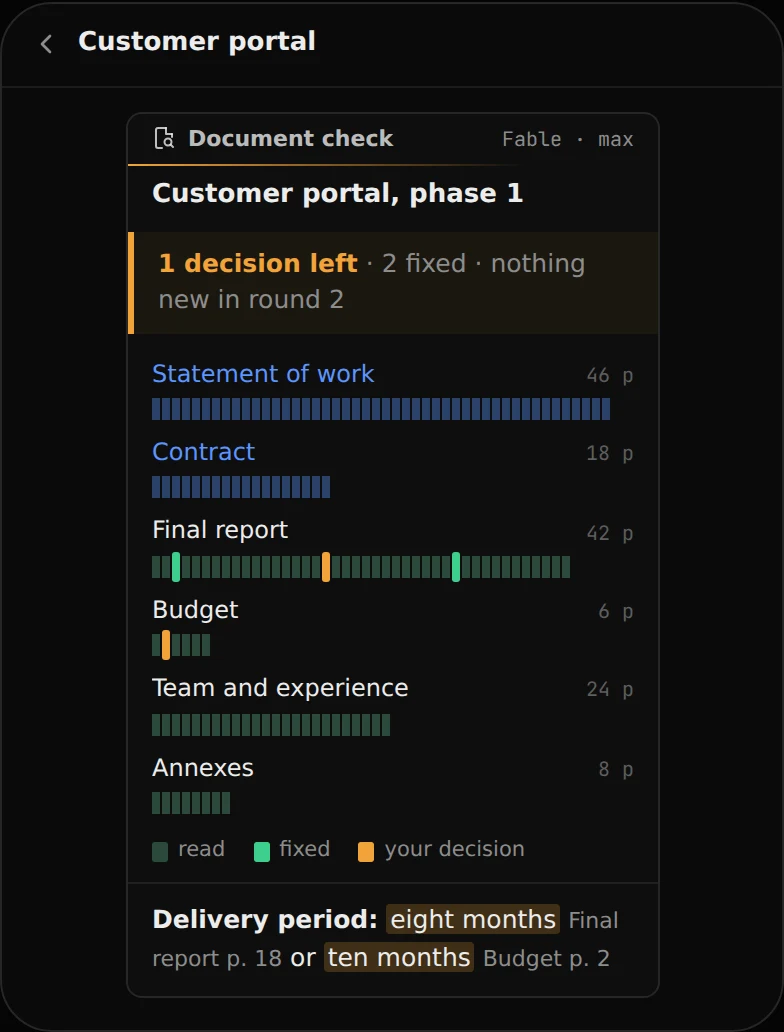
Each document is a strip of its pages. Read pages are dark green, the reference documents blue, and a mark sits on each page where something was fixed or waits on the operator. The clash is one line underneath.

In the chat
B on a desktop
Desktop. 144 pages, three marks on the final report, one on the budget.
B on a phone
Phone. Names above their strips.
Why it could work

Shows at a glance that no page was skipped, and where in the set the trouble sits.

What it costs

The quotes shrink to one line. A set of 400 pages makes thin strips.

Keys

None.

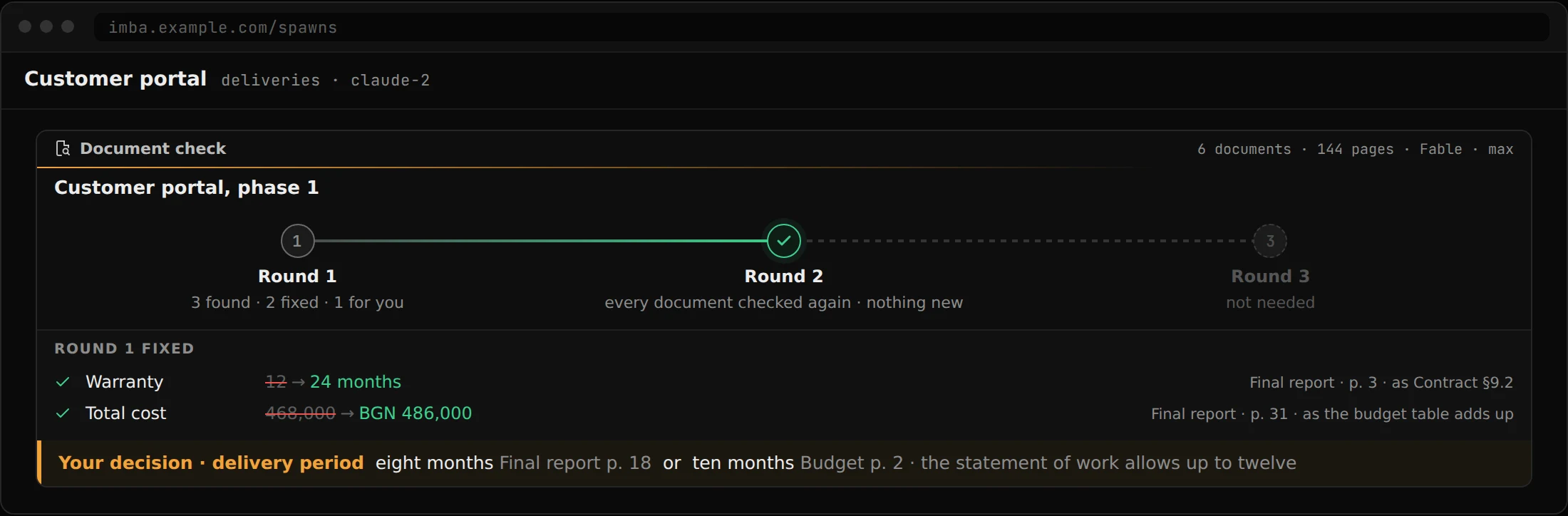
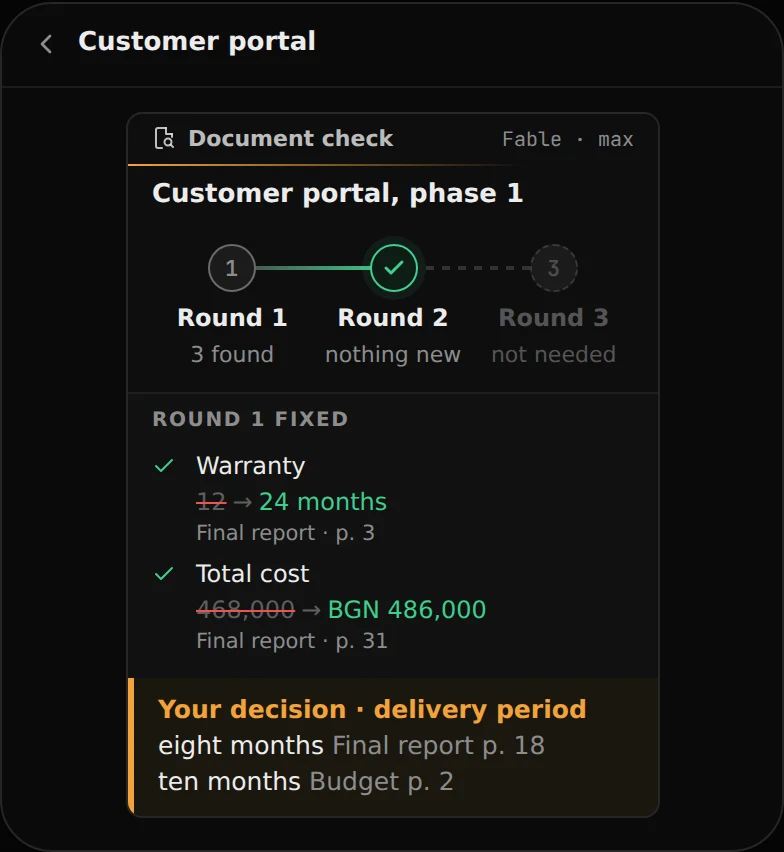
The run is told as its rounds: one step per round, the clean one ringed in green, the unused one dashed. What each round fixed sits under the steps, and the open decision closes the card.

In the chat
C on a desktop
Desktop. Round 1 found three, round 2 found nothing new, round 3 was not needed.
C on a phone
Phone.
Why it could work

Makes the loop visible: the operator sees that a second full check found nothing.

What it costs

With a limit of 10 the steps crowd. The clash shows as values, not sentences.

Keys

None.

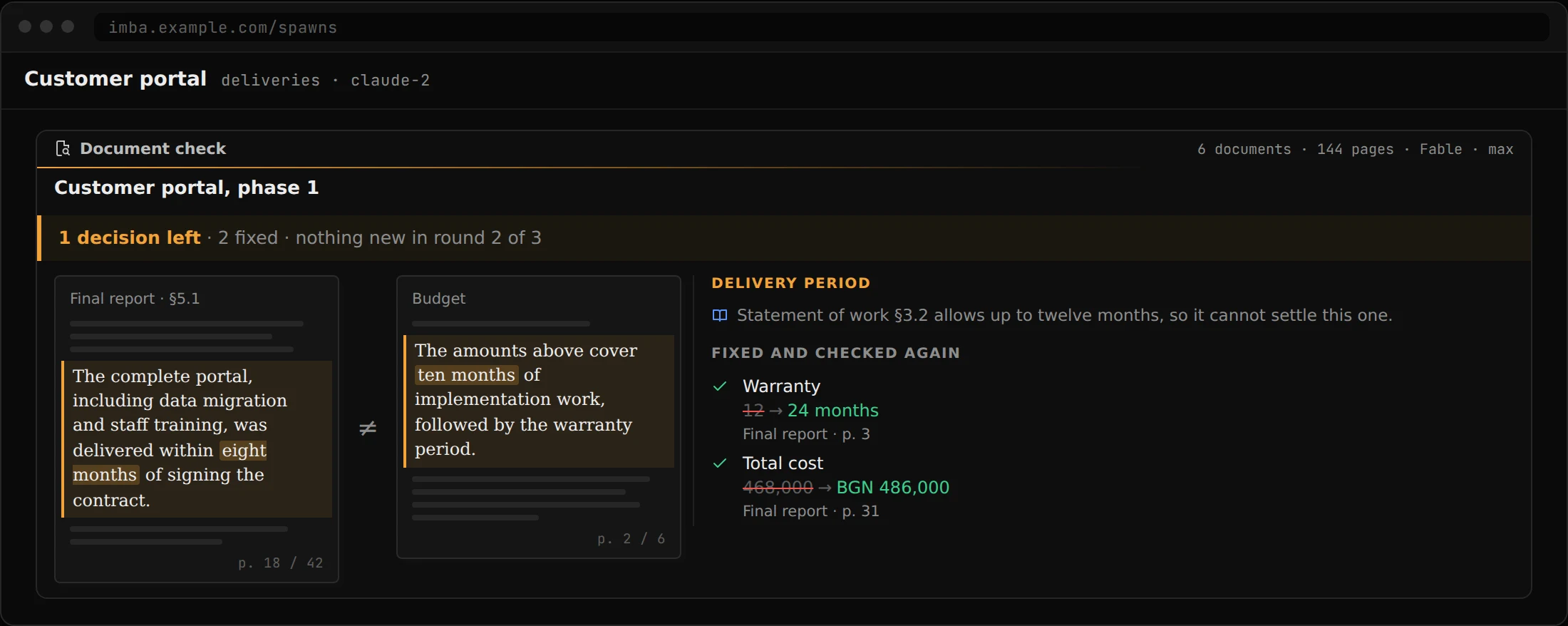
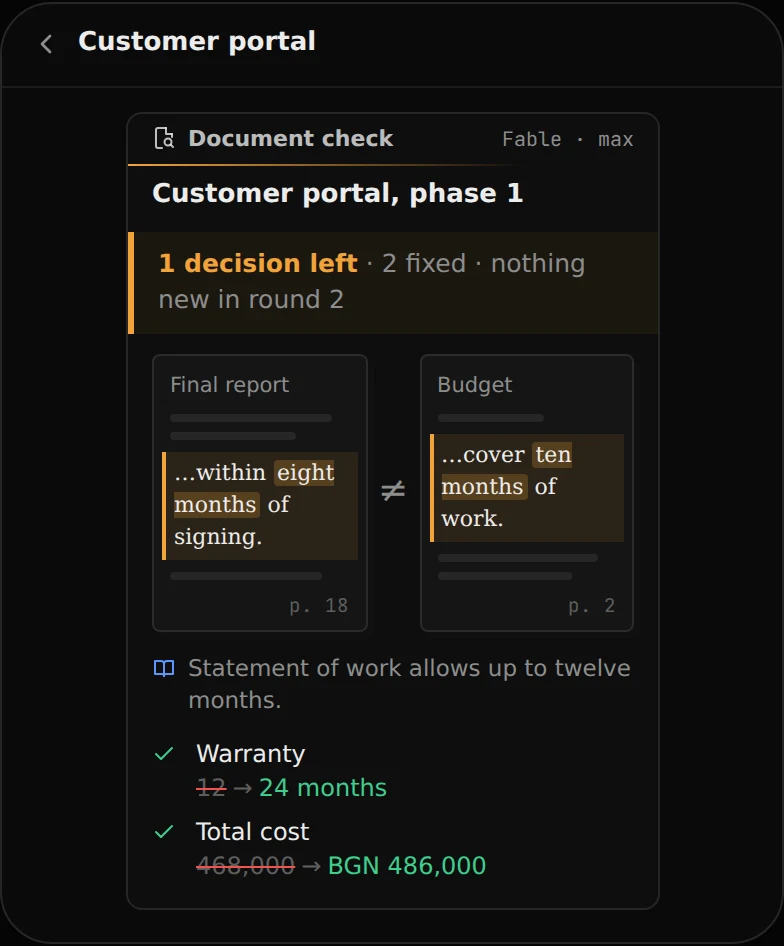
The two clashing sentences are drawn in place on small pictures of their pages, side by side, with a not-equal sign between them. The fixes sit to the right.

In the chat
D on a desktop
Desktop. Page 18 of 42 against page 2 of 6.
D on a phone
Phone. Two small pages, the fixes below.
Why it could work

Closest to how a reviewer checks by hand: two pages open next to each other.

What it costs

The page pictures take room and carry no extra facts.

Keys

None.

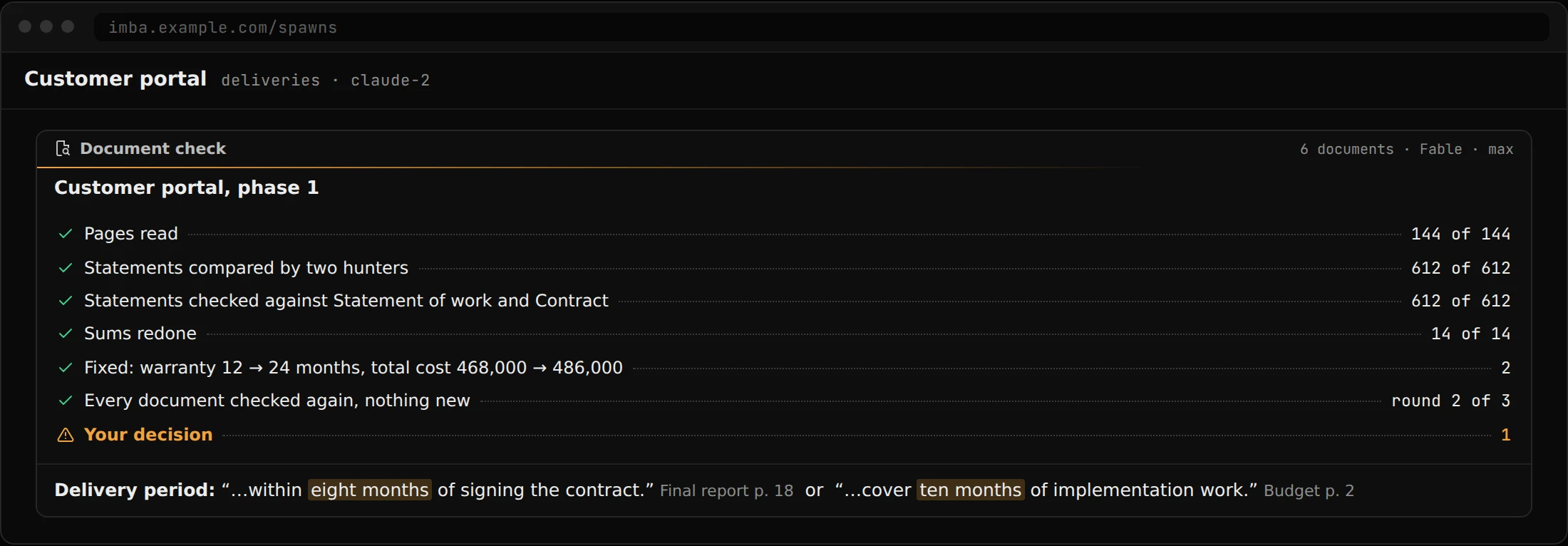
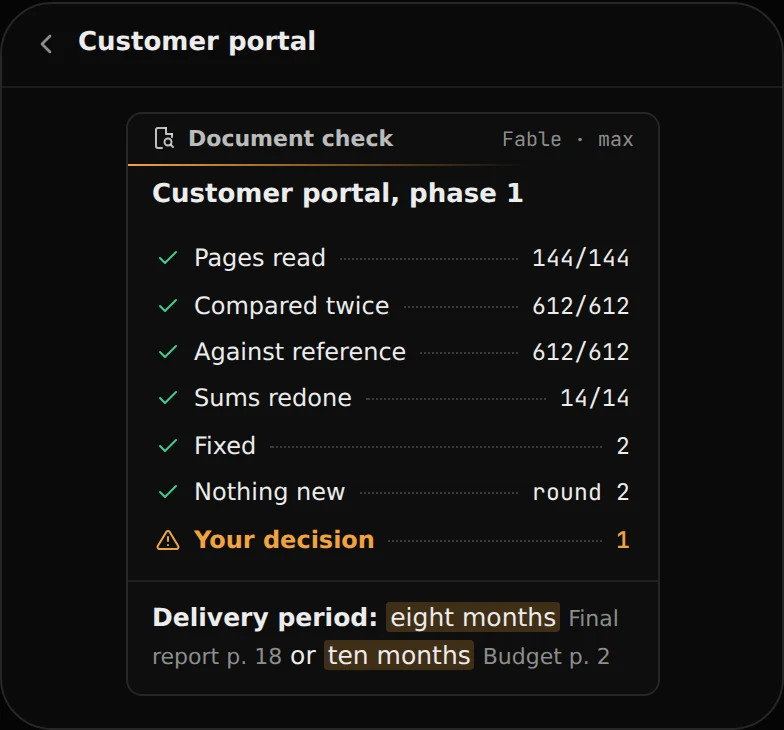
Every step of the run is a ticked line with its count, like a till receipt: pages read, statements compared, sums redone, fixes and rounds. The open decision is the last line, in amber, with the clash under it.

In the chat
E on a desktop
Desktop. Seven lines, the clash quoted underneath.
E on a phone
Phone. Short labels, the same counts.
Why it could work

The plainest proof that the run did all its work.

What it costs

Reads as counts first, which is what this card was asked not to be. The clash is one line at the bottom.

Keys

None.

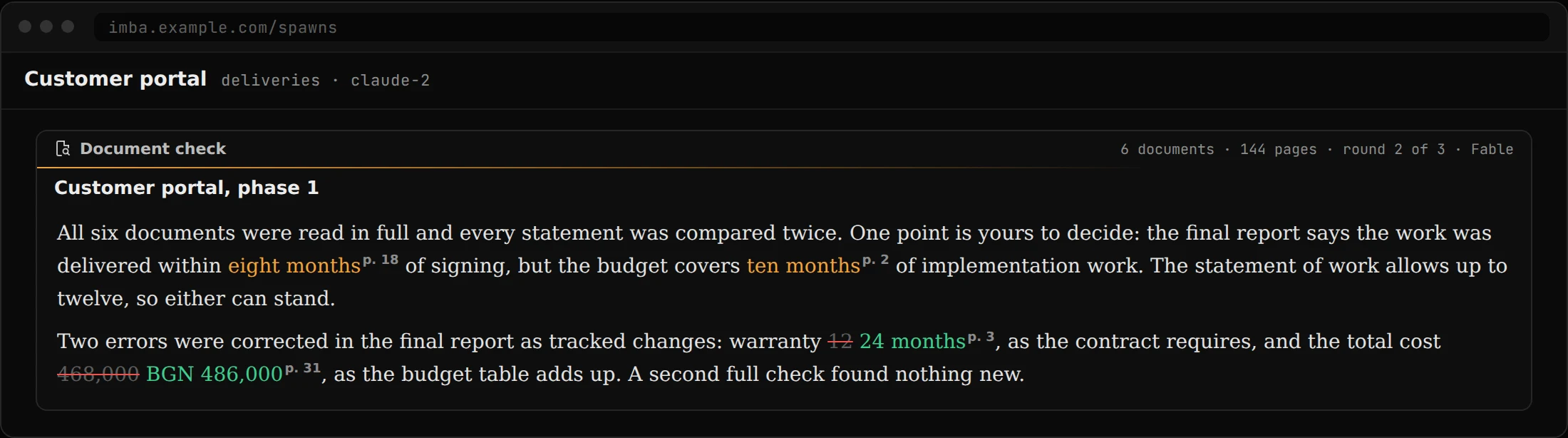
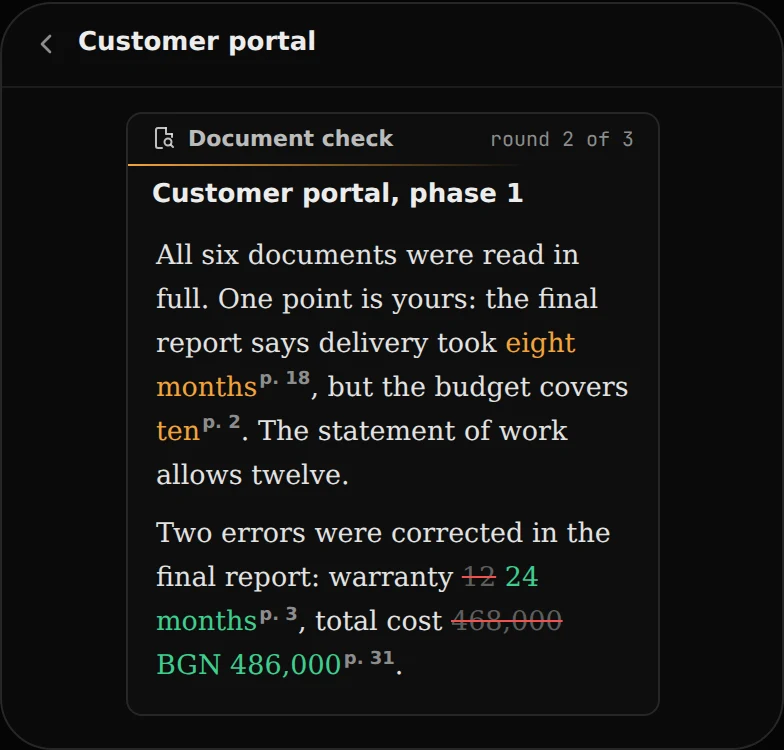
The result is written as a short note to the document owner, with page numbers as small marks and the old values struck through.

In the chat
F on a desktop
Desktop. Two paragraphs: the decision, then the fixes.
F on a phone
Phone.
Why it could work

Can be pasted into an email to the team as it stands.

What it costs

Nothing stands out at a glance. A run with eight clashes makes a long note.

Keys

None.

Side by side

LookClash in its own wordsFixes shownPages read shownRounds shownHeight on a phone
AVerdict firstYes, on two slipsOld to newOne lineThree dots678 px
BEvery pageOne lineMarks onlyEvery pageIn words515 px
CThe roundsValues onlyOld to newNoEach round425 px
DThe two pagesYes, on the pagesOld to newNoIn words472 px
EThe receiptOne lineOne lineWith countsOne line364 px
FThe memoIn the noteStruck throughIn wordsIn the head374 px